Choose the lightest workable routine
Start with the clothes you are taking and the facilities available. A hotel may provide an iron and board on request, while a longer stay may justify a laundrette or professional pressing service. Check availability rather than assuming it. Choosing fabrics that tolerate normal travel creasing can also reduce the need to carry a heated appliance, especially when luggage space and departure time are tight.
A steamer is not a washing machine. It may help relax wrinkles on suitable fabrics, but it does not remove all dirt, oils or stains. Do not treat a general garment appliance as a disinfecting or pest-control device unless a specific, validated use is supported by its manufacturer and relevant guidance. Normal clothes-care advice is not an adequate response to a suspected infestation.
Inspect both the appliance and garment labels
Read the electrical rating on the exact iron or steamer, including voltage, frequency and power. Some travel irons have a manual selector; others do not support more than one supply. A compact steamer can still have a substantial power demand. Never assume that an adapter or a USB-looking accessory makes a mains-powered heating appliance internationally compatible.
If a selector is fitted, follow the instructions for changing it while the appliance is disconnected. A setting that worked on the previous trip may be wrong for the next destination. Check the cord, plug and housing before departure and again if the appliance has been dropped. Do not use tape or an improvised plug arrangement to work around damage.
The garment care label is a separate constraint. ISO 3758 describes a system of textile-care symbols, and GINETEX provides information about care labelling. An iron symbol, its dots or a crossed-out symbol needs to be interpreted correctly. Decorations, coatings, adhesives and mixed materials can change how a garment responds even when the main fabric seems familiar.
Steam needs space and a safe direction
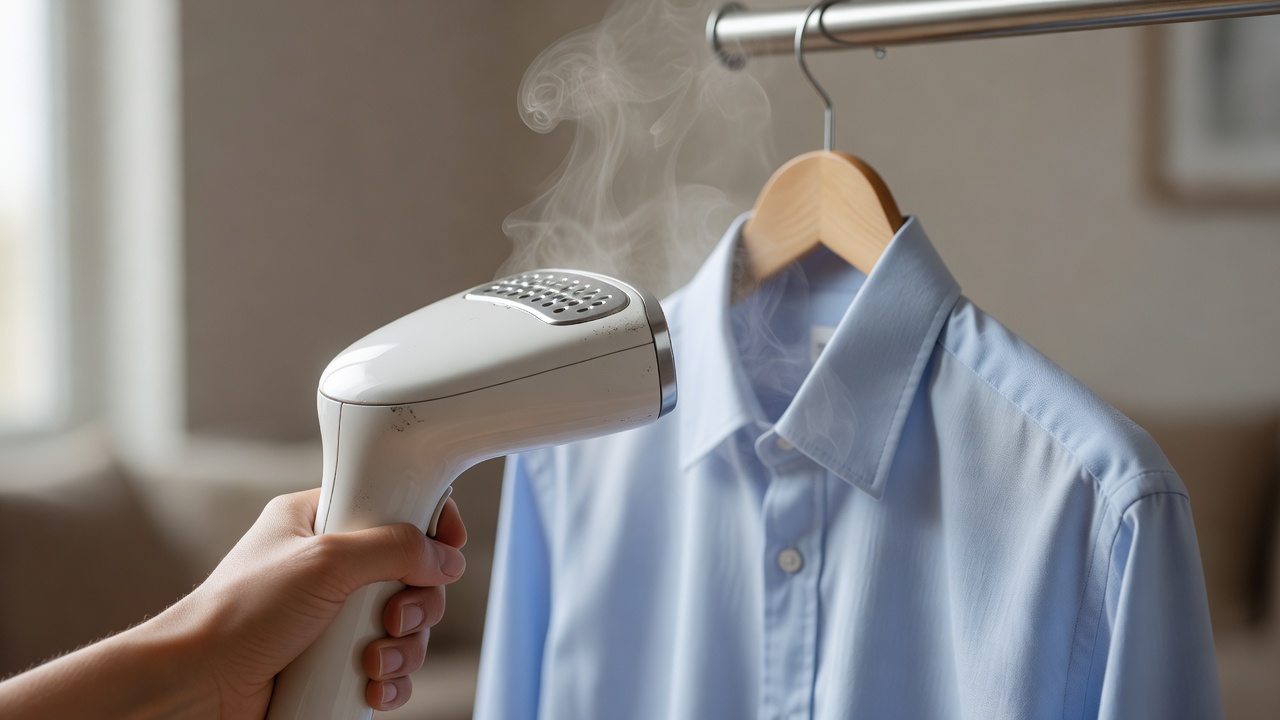
Never steam clothing while someone is wearing it. Keep the steam outlet away from skin, other people, pets and electrical equipment. Position the garment using an arrangement permitted by the appliance instructions, and check that nearby surfaces will not be damaged by moisture or heat. Do not turn a door, smoke detector or improvised hook into a setup that creates another hazard.
Some steamers must stay upright; others support specified alternative positions. Follow the exact model's limits rather than copying a demonstration for another product. Tilting can cause hot water to spit or leak on unsuitable designs. Stop if water escapes unexpectedly, the appliance behaves abnormally or the instructions cannot be followed in the available space.
An iron needs more than a flat surface
Use an appropriate ironing board or a surface explicitly suitable for the task. Bedding, carpet, a luggage rack and a hotel desk are not safe substitutes merely because they appear level. Follow the rest-position instructions and keep the hot soleplate and cord clear of anything that could scorch, melt or fall. Automatic shut-off is a backup feature, not permission to leave the appliance unattended.
Begin with the garment's allowed setting and follow the appliance guidance. Where a test on an inconspicuous area is appropriate, it does not override a prohibition on ironing or steaming. Delicate trim and synthetic materials can be damaged rapidly. If a garment is important and the label is unclear, professional advice may cost less than replacing it.
| Option | Useful question | Do not assume |
|---|---|---|
| Travel iron | Is there a proper board and compatible supply? | That “travel” means automatic dual voltage |
| Garment steamer | Can it be used in the required orientation? | That all fabrics tolerate steam |
| Provided equipment | Is it available, intact and ready to use? | That every room includes it |
| Local service | Does the turnaround fit the trip? | That same-day work is guaranteed |
Water and drying are part of the schedule
Use the water type specified by the manufacturer. Do not add fragrance, detergent or descaler unless expressly permitted. Different appliances have different requirements for tap, distilled or treated water, so there is no universal refill rule. Empty and clean the reservoir as directed, taking care not to wet electrical openings.
Freshly steamed clothing may need time to dry before wearing or packing. A humid room can slow that process. Make a separate plan for genuinely wet laundry: covering a heater or blocking ventilation with clothes can create risks and may violate accommodation rules. Steaming is not a substitute for a permitted drying arrangement.
Build in a cool-down window
Unplug after use and leave the appliance in its approved resting position until fully cool. A pouch is only suitable for a warm appliance if the manufacturer explicitly says so, and it does not make every surrounding bag material heat-resistant. Before checkout, empty where instructed, dry the equipment and protect the controls and cable without tight bends.
IEC 60335-2-3 covers electric irons, while IEC 60335-2-85 concerns fabric steamers. These are useful reference points, not personalised travel approval. For product alerts, consult the US Consumer Product Safety Commission recall database or the European Commission's Safety Gate, as relevant to your product and market. Match the model details rather than relying on visual resemblance.