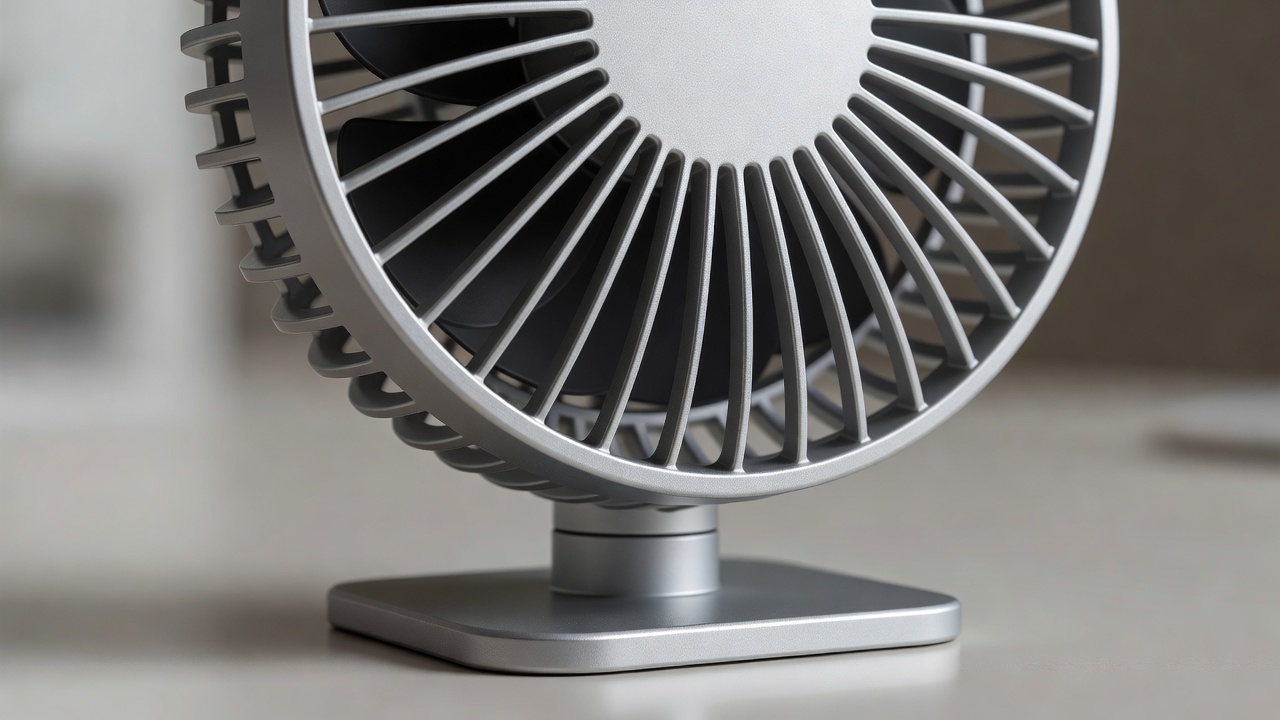
Separate airflow from refrigeration
A fan moves air; it does not refrigerate a room. Air movement can help comfort and evaporation under appropriate conditions, but the result depends on air temperature, humidity, clothing and the person using it. A miniature evaporative cooler is different again: it uses water evaporation and is generally less effective in humid conditions. Neither should be described as equivalent to a properly sized air conditioner.
Before buying or packing a device, consider the actual setting. A quiet fan may be useful beside a desk with a dependable power supply. A handheld unit may help briefly while waiting outdoors, but it occupies a hand and has limited battery life. A neck fan adds moving parts close to hair and clothing. Choose around the intended use and manufacturer restrictions rather than a broad claim of “cooling anywhere.”
Read both sides of the charging chain
For a USB-powered fan, check the fan's input requirement, the cable specification and the charger output. Then check the charger's mains input against the destination supply. These are separate checks. A wide-input charger may work with more than one mains voltage, but that must be stated on its label. The plug arrangement must still be appropriate and properly rated.
USB-C describes a connector system, not a promise that every combination will deliver every power level. USB Power Delivery uses supported power profiles and negotiation; the device, power supply and cable need to support the required arrangement. Follow the equipment instructions and use suitable, undamaged components. Do not force a voltage using an improvised cable or trigger accessory.
The USB Implementers Forum provides technical context for USB specifications. IEC 62133-2 concerns safety requirements for certain portable rechargeable lithium cells and batteries. Neither reference is a reason to trust an unidentified charger or a damaged battery. A logo, marketplace title or connector shape is not a complete safety assessment.
Treat batteries as a separate travel task
Find out whether the battery is built in, removable or supplied as a separate power bank. Record its marked watt-hour rating when available. For a battery with a stated nominal voltage and capacity, watt-hours can be calculated as nominal volts multiplied by amp-hours; milliamp-hours must first be divided by 1,000. Do not use the USB output voltage in place of the battery's nominal voltage, and do not rely on a calculation to override carrier documentation requirements.
Check current rules with the airline and relevant transport authority before departure. Requirements can differ for installed batteries, spare batteries and power banks. Quantity limits, approval conditions and restrictions on in-flight use or charging can also vary. The International Air Transport Association passenger guidance and the Federal Aviation Administration PackSafe resource are useful starting points, but your operating carrier's rules still need checking.
Protect spare battery terminals from short circuits and prevent accidental activation. A damaged, swollen or recalled battery should not be treated as ordinary luggage. Follow the manufacturer's and transport authority's instructions rather than attempting a repair or carrying it “just in case.” If a cabin bag is taken for hold loading at the gate, review the battery items that must be removed under the applicable rules.
| Device | Main dependency | Important limit |
|---|---|---|
| USB desk fan | Suitable cable and power supply | Airflow, not room refrigeration |
| Rechargeable fan | Battery condition and charge | Runtime varies with speed and conditions |
| Evaporative cooler | Water, maintenance and suitable humidity | Not equivalent to air conditioning |
| Mains fan | Compatible supply and safe placement | Plug shape alone is insufficient |
Use and charge in a sensible place
Keep grilles clear of clothing, hair and loose objects. Put a desk fan on a stable surface and route its cable where it will not be pulled. A clip attachment is only useful if the support and permitted orientation suit the device. Do not hang equipment over someone sleeping or use it near water unless its instructions explicitly support that environment.
Charge as directed, on a suitable surface with ventilation. Avoid charging under bedding or inside a packed bag. Stop using equipment that becomes unusually hot, smells abnormal or shows damage. Runtime claims often depend on a specific speed and test setup; plan for less convenient real-world conditions rather than assuming a full day's use from an advertising headline.
Keep a heat-safety plan outside the bag
Check local weather alerts and public-health advice. The World Health Organization's heat and health guidance describes risks that portable airflow cannot solve. In very hot conditions, a fan alone may be inadequate or inappropriate. Access to a genuinely cooler place matters, especially for older people, infants and people with relevant health conditions.
Plan breaks, shade and fluids appropriate to your circumstances and any clinical advice. If someone becomes confused, collapses or is seriously unwell in the heat, seek urgent local medical assistance; do not keep adjusting a fan while delaying help. This notebook is not medical advice. The best portable cooling choice is one that supports a sound plan without encouraging you to remain in unsafe conditions.